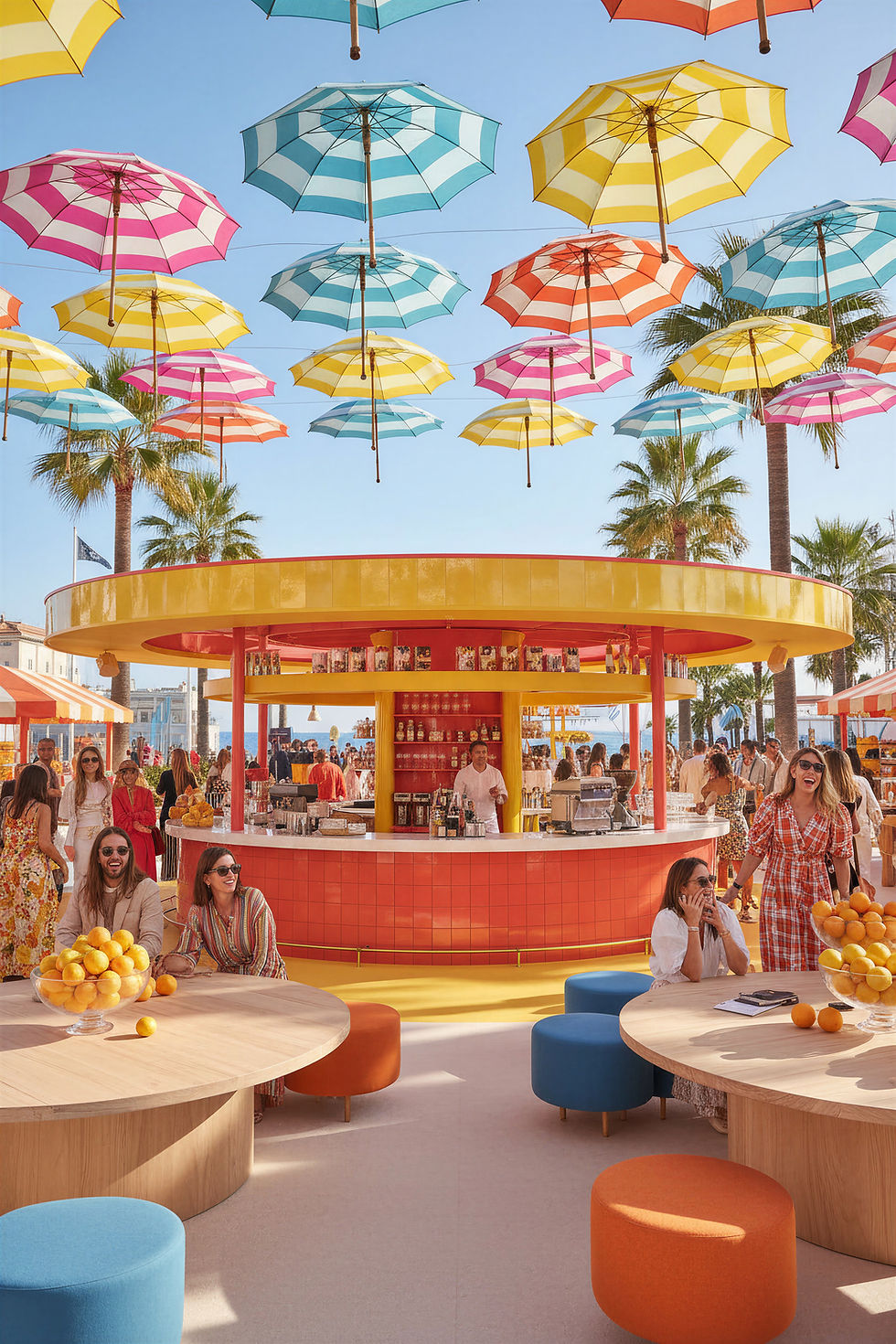
What Copenhagen Fashion Week Can Teach Us About Brand Experience
How fashion’s use of colour, texture, transparency and scale can inspire more distinctive physical brand experiences.
Fashion is one of our favourite places to look for creative signals.
It constantly experiments with colour, proportion, texture, material and movement, often long before those ideas find their way into other areas of design and culture.
For brand experience, we’re interested in how those ideas could translate from something we wear into something we can physically step inside.
Copenhagen Fashion Week gave us plenty to think about...
Colour can become part of the architecture

Turquoise was difficult to miss in Copenhagen. What interested us was the confidence with which it was being used. Rather than appearing as an accent, colour took over.
That principle becomes interesting when translated into a physical brand experience.
Colour can define zones, influence mood, guide movement and change how people perceive a space. Light can shift its appearance, reflective materials can multiply it, and details such as food, drink, furniture and uniforms can carry it throughout the experience.
Used with intention, colour becomes part of the architecture. For brands with established visual identities, there is an opportunity here to go further than applying brand colours to graphics and signage.
A colour palette can influence how someone physically experiences the brand.
Give people something they want to touch
Fringe, feathers, ruffles and tactile materials appeared throughout Copenhagen Fashion Week.
Fashion understands that texture changes our relationship with an object. The same is true of environments.

A textured wall invites a different response from a printed graphic. A soft surface changes how a space feels. Materials that move or respond to touch can create curiosity before anyone has explained what is supposed to happen.
This becomes particularly interesting when we think about physical brand identity.
Material choices communicate something. Depending on how they are used, a brand can feel natural, precise, playful, industrial, soft, crafted or futuristic.
Within our 7S Design System™, sensation is considered alongside sight because the way something feels can carry as much meaning as the way it looks.
Use layers to create curiosity
Sheer fabrics were another recurring signal, creating layers that revealed and concealed at the same time.
Spatial design can use the same principle.

Screens, fabrics, lighting, translucent materials and layered structures can give people glimpses of what lies beyond without revealing the whole experience immediately.
This allows curiosity to become part of the journey.
Rather than seeing everything from the entrance, the audience can discover the experience gradually as they move through the space. Information can appear at different stages, sightlines can hint at what comes next, and key moments can be held back until the right point in the journey.
Physical experience gives brands an unusual amount of control over sequence. We can think carefully about what someone encounters first, what draws them further into the space and how the story develops as they explore.
Take brand patterns off the page
Polka dots also appeared across Copenhagen Fashion Week, often oversized and deliberately imperfect.

For us, the interesting opportunity is translating a two-dimensional visual device into something physical.
A dot could become seating or lighting. It could influence the architecture, food presentation, an interactive object or a suspended installation.
The same thinking can be applied to distinctive elements already within a brand identity, from typography and graphic devices to packaging forms and shapes within a logo.
Brand experience gives us the opportunity to explore what familiar assets could become at a completely different scale.
Done well, an environment can feel unmistakably connected to the brand without relying on logos across every surface.
Design for movement
Fashion is experienced in motion.
Fabric changes as someone walks. Fringe responds to movement. Layers shift and reflective surfaces change depending on where you stand.
Physical environments behave in much the same way.
People approach them from different directions, move through them, look back and experience them alongside other people. That means designing a space purely around the hero photograph only captures one part of the experience.
Movement can be considered from the beginning.
A feature might reveal itself gradually as someone approaches. Materials can respond to interaction. A change in lighting can signal the next part of the journey. Different viewpoints can reveal different details.
Thinking about movement gives us another way to make a physical brand experience feel dynamic without relying on constant programming or technology.
Translating fashion into brand experience
Copenhagen Fashion Week gave us signals around saturation, tactility, layering, scale, repetition and movement.
These become creative ingredients that can be considered against the brand, audience and objective.
At Just Honest Agency, we use our Experience Architecture™ and 7S Design System™ to translate inspiration from fashion, design, hospitality, art and culture into physical experiences that make sense for the brand creating them.
We look widely for inspiration, then make deliberate decisions about what belongs.
The strongest result is an experience that feels recognisable as the brand itself, with cultural and creative signals interpreted in a way that feels distinctly its own.
Bringing your brand into the real world?
We translate brand strategy and visual identity into physical experiences designed around how people move, interact and feel within the space.
Talk to Just Honest about your next brand experience.
Always Honest. Never Ordinary.
Just Honest: Bold, Unforgettable, Brand Experiences
Follow us for behind-the-scenes magic, experience tips and industry trends:
Disclaimer
The content published on this blog is for informational and inspirational purposes only. While we strive to provide up-to-date insights, expert opinions, and industry trends, the information shared should not be considered as professional advice tailored to any specific event or business need. All views expressed in our blog posts are our own and are intended to inspire creativity, spark innovation, and provide valuable insights into the world of brand experience, event marketing, experience design, event design and event management. However, event strategies, technologies, and trends evolve rapidly, and we recommend consulting with a professional before making any major event or experience-related decisions. Additionally, any third-party tools, platforms, or services mentioned in our blog posts are referenced purely for educational purposes. We do not endorse or receive compensation for mentioning them unless explicitly stated.
By using this blog, you acknowledge that we are not responsible for any direct, indirect, or consequential decisions made based on the information provided. We encourage readers to use their discretion, conduct their own research, and reach out for personalized guidance if needed. For expert consultation on experience marketing strategies, sustainable event planning, or creating unforgettable brand experiences, feel free to contact us directly.
© Just Honest Events and www.justhonestagency.com 2026. Unauthorized use and/or duplication of this material without express and written permission from this site’s author and/or owner is strictly prohibited. Excerpts and links may be used, provided that full and clear credit is given to Just Honest and www.justhonestagency.com with appropriate and specific direction to the original content.